Tuesday, December 6, 2011

Vegas to Reno 2011 Recap

When you decide to run Vegas to Reno the adventure doesn't start when you pull up to the Red Bull arch over the start line. It doesn't start when you roll through tech and get your inspection sticker, or even when you step off the plane and into the Las Vegas airport. It starts weeks before the event, as all the planning and logistics are put together. Who's going? Who isn't? Where are we staying? Where do we need to be and when? What do we need for vehicles? Supplies? Fuel? Food? Days of planning, calculating, confirming, all for a 500 mile run through the Mojave Desert. At the end of the calculating and logistical madness we were looking at a planned seven days in Nevada, staying five nights in three different hotels, and one night chasing our truck through the desert. Our people would be coming from five states in three time zones. Three chase vehicles; a rented U-Haul box truck and trailer, a rented Jeep Compass, and a heavy duty pickup owned by Doug Nagy, one of our scheduled drivers. Five scheduled pit stops, one driver change at the halfway point, 110 gallons of race gas, over 200 gallons of fuel in the chase vehicles (not including the tow back home), and a target finish time of about 17 hours. The logistics were set, we were ready to race.

The trip itself began on Tuesday the 16th. Most of our crew (a small group for this trip as many scouts couldn't get time off from their summer jobs) flew out of Logan, arriving in Vegas just after noon. We met up with Scott Nickerson, one of the co-drivers, who had arrived twelve hours earlier. The rental Jeep was procured, we checked into our first hotel (Texas Station), and prepared for the madness that was to come tomorrow, beginning with a shop tour at Riot Racing. Even though our internal clocks were still on New England time, sleep was hard to find that night. It still didn't feel real.

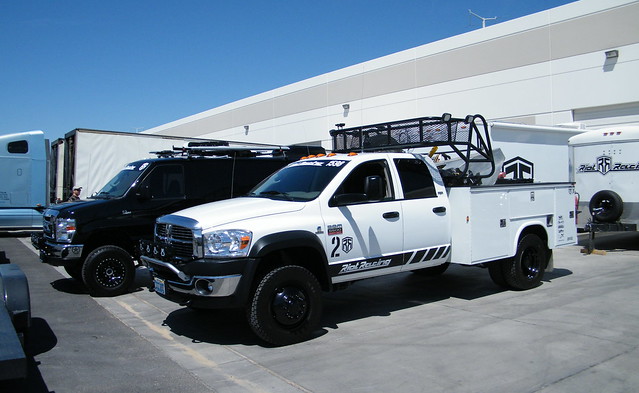
Wednesday began early, with an abbreviated breakfast followed by a trip to U-Haul to pick up the truck and trailer. Once we had the truck we headed back to the airport to get rally racer John Cassidy, one of the drivers, and made a beeline for Henderson and the Riot Racing shop. We arrived at what initially seemed like a nondescript industrial building, with nothing but the Riot logo on the glass door confirming we were at the right place. Driving around back, however, and the low-key image vanished. A collection of heavily equipped, HID-adorned chase trucks and trailers sat in front of a large overhead door, ready to go charging into the night after any race vehicle needing assistance. After circling each truck with longing gazes we stepped inside the shop, and into a different world. There were three race cars in the shop, two limited class buggies and the Riot trophy truck, all three stripped down to their frames, along with the Riot prerunner, which sat stealthily beneath a black car cover. On one wall was a shelving complex holding dozens of massive BF Goodrich tires, the top row well out of reach for anything short of a forklift, which conveniently sat nearby. Above the tires were the trophy truck's body panels, mounted on the wall like the art they most certainly were. Jordan Poole, co-driver of the Riot Racing trophy truck greeted us with a smile, leading us around the shop, answering our questions, and showing us the intricacies of each vehicle. After an hour or so of racers discussing racing we left, though not before Jordan had provided us with a healthy supply of Riot Racing stickers and posters.

 Some of the chase trucks behind Riot Racing HQ
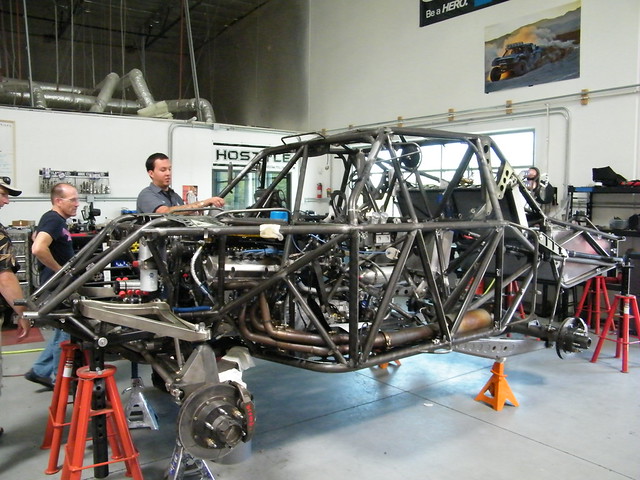
Jordan Poole showing John and Scott the trophy truck

From Riot we headed to Aliante Station, a hotel on the northern edge of Las Vegas. Aliante Station was the Las Vegas base for the race, and on this day was the registration point for time trials. Time trials were for the unlimited class vehicles, trophy trucks and class 1 buggies only, but spectating is often allowed along certain parts of the qualifying course, so we went to time trial registration and picked up the directions to the course. Qualifying, as it turned out, was being held in the desert about 15 miles northeast of the city, so we piled back in the cars and headed for the desert. We arrived as cars were running their practice lap (each car got one practice/recce lap), some drivers choosing the flat out approach to get a feel for the speed of the course, others opting to take it easy and find all the hidden gotchas. We parked amidst the steadily growing crowd of fans and watched the trucks race by, getting coated in dust as each screamed past.

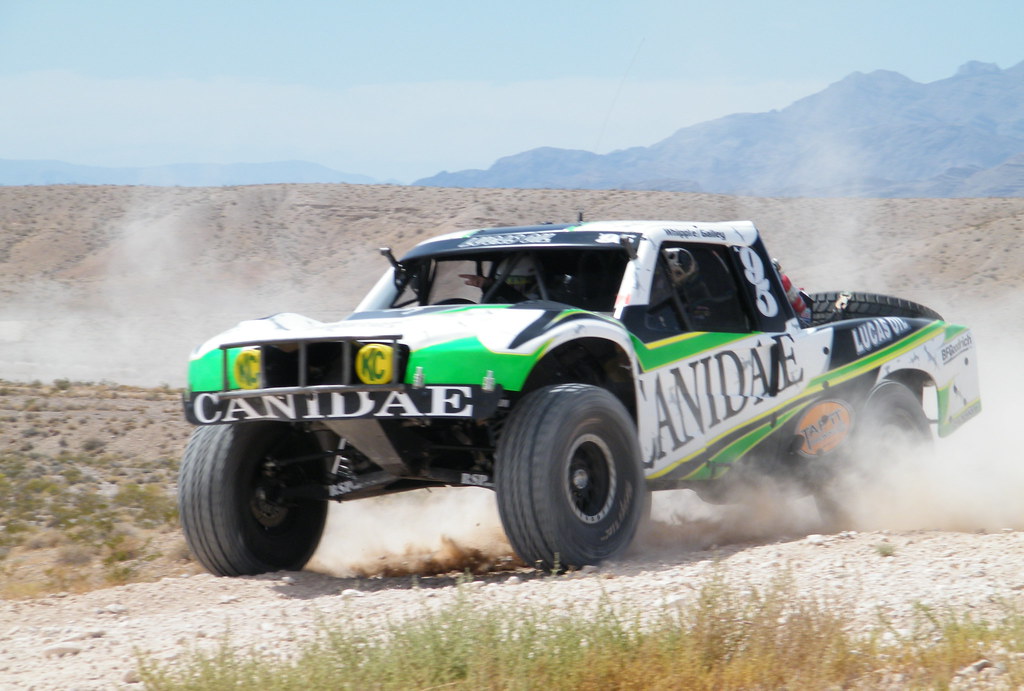
The Canidae trophy truck on its practice lap

As we enjoyed the show our fourth and final driver, Doug Nagy, arrived, having driven from his home in California. With the team almost complete (our last member scheduled to arrive late that evening), we headed to Alamo, Nevada to finally see our steed for this race.

We arrived in Alamo around sunset, pulling into the driveway with the sun still peeking defiantly over the mountaintops. Outside the garage sat our chariot, the menacing black monster that would take us into battle on the desolate battlefield that was the Mojave desert. After a few minutes of talking about the truck, its controls, and its parts Steven went off with one of the truck's previous drivers to learn how to properly drive it. The rest of the team meanwhile started loading the U-Haul with the boxes of spares that came with the truck. After fifteen minutes the race truck rolled back into the driveway and Steven climbed out, the edges of a massive grin visible beneath his helmet. One by one each of our four drivers got a turn out in the desert with the new truck, feeling out its (and the drivers') abilities and limits. John and Doug, who were the most experienced racers and also scheduled to be in the truck together on race day, spent the most time testing, exploring the Alamo desert for about an hour before returning. In this time Steven discussed race strategy with the truck's former owner. He voiced the intention to do the driver change at the halfway point and was met with the question "Are you insane?" The man told us that they always tried to do driver changes every hundred miles or so, never exceeding 150 mile shifts. Anything longer than that tended to excessively wear a racer down. And with that our months of planning went partially out the window.
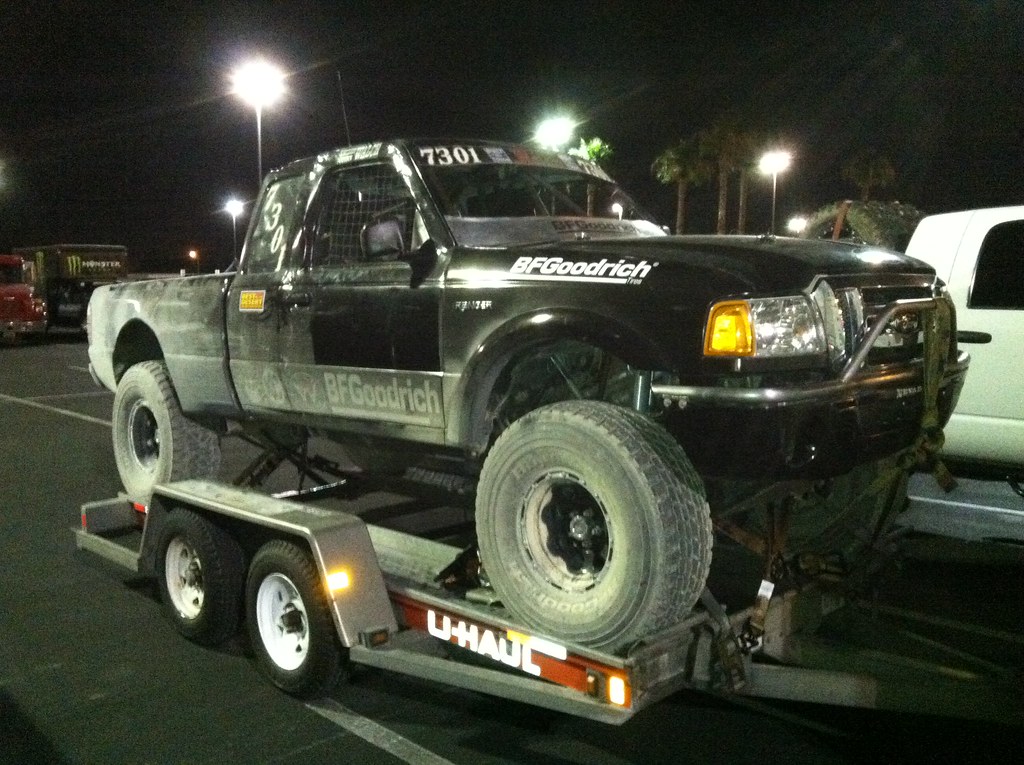
The new race truck

John and Doug returned and we loaded up the truck and the last of the gear and headed back for Vegas, this new revelation weighing on our minds. Once back at the hotel we took out the mileage chart and our pit strategy and began rearranging. The original plan was for Steve to drive the start to mile 289 with Scott as co-driver, then hand it off to Doug with John co-driving until mile 416, at which point John would take over driving duties from Doug and the two would take it to the finish. With a little quick recalculating we added two driver changes without affecting anyone's race mileage much. Steve and Scott would start, as planned, but would either stop at mile 159 or 99 if the triple digit heat proved to be too much. From 159 Doug would take over with John and take it to mile 289, where Steve and Scott would get back in, bringing it to mile 416 for John to take it home to the finish at mile 552. It meant an extra stop, but it would keep the drivers fresher. With that settled we went to bed. Registration and inspection were the following day.

We woke up around 9 and, after breakfast, went over the truck and the day's plan. We were going to check out of the Texas Station and, after inspection and the drivers' meeting, check into Longstreet Inn, a lone hotel located in the middle of nowhere on the California border, but within 45 miles of the start line (Las Vegas was about 2 hours from the start). The truck needed a few safety supplies, namely an emergency triangle, tool kit, and first aid kit, but was otherwise ready to go. We split up, with John and Doug going after the gear and the rest of us going straight to Aliante Station for inspection.

Desert inspection is a funny thing from a rally driver standpoint. In rally you typically line up at some nondescript garage and roll patiently roll through one at a time, get inspected, and go on your way. The line is always short because there's only 40 or so competitors. Thanks to the 300 vehicles at a desert race, the inspection line is a snaking parade of color and noise. Vendor trailers line the route, selling everything from DVDs to fan apparel to firesuits and radios for your race car. We didn't have any numbers for our truck yet, so our first stop along the route was the SignPros trailer (first trailer in the line) to get some new vinyl. As we were waiting for our numbers (and it was an impressively short wait) we discussed the project and the scouts and the SignPros crew decided to give us the vinyl for free. It was an incredible gesture. From there we rolled through the line, trying not to melt into the asphalt on the 110° day. We visited a few more trailers, making sure to stop for some Fast-Aid stickers for the truck. After about an hour we finally made it to the front of the queue. Our truck was poked, our firesuits were groped, and after about ten minutes our truck and safety gear was given a pass. We loaded the truck back on the trailer and quickly went inside for some drinks and air conditioning.

Next in line to be inspected. Our mascot Bacon the Dinosaur is enjoying the sun

Some of the course markers set up at registration

The day was winding down astonishingly quick and we still had the driver meeting at 6, followed by the 100 minute drive out to the hotel. After some strategizing we decided to send Ron ahead to the hotel to check us into the rooms (the desk closed at 9). The rest of us had dinner then went to the drivers meeting.
The size of the meeting was amazing. Between drivers, co-drivers, and a few crew members who decided to listen in there were about a thousand people in attendance. Casey, the head of Best In The Desert, talked about race procedure, the course, and what to expect over the next two days. As he talked we found ourselves excitedly fidgeting in our seats. Race day was almost here. The meeting ended and, after filling our coolers with food and drinks and our gas tanks with fuel, we hit the road to Longstreet.

Arriving at the hotel around 11:00 we immediately got to work on the truck. The GPS wasn't installed yet and with three desert novices on the team this was something we certainly wanted to have. We fought the unfamiliar wiring system for over an hour, but made little progress. Exhausted we decided to give it up for the night, get some sleep, and see if we couldn't fix it in the morning.

7 am, race day. We got up, excited but uncertain. We were beginning to realize the size of our undertaking. With surprisingly little discussion we loaded up our gear and, after another couple hours of battling the GPS and having the same amount of luck, headed for the start.
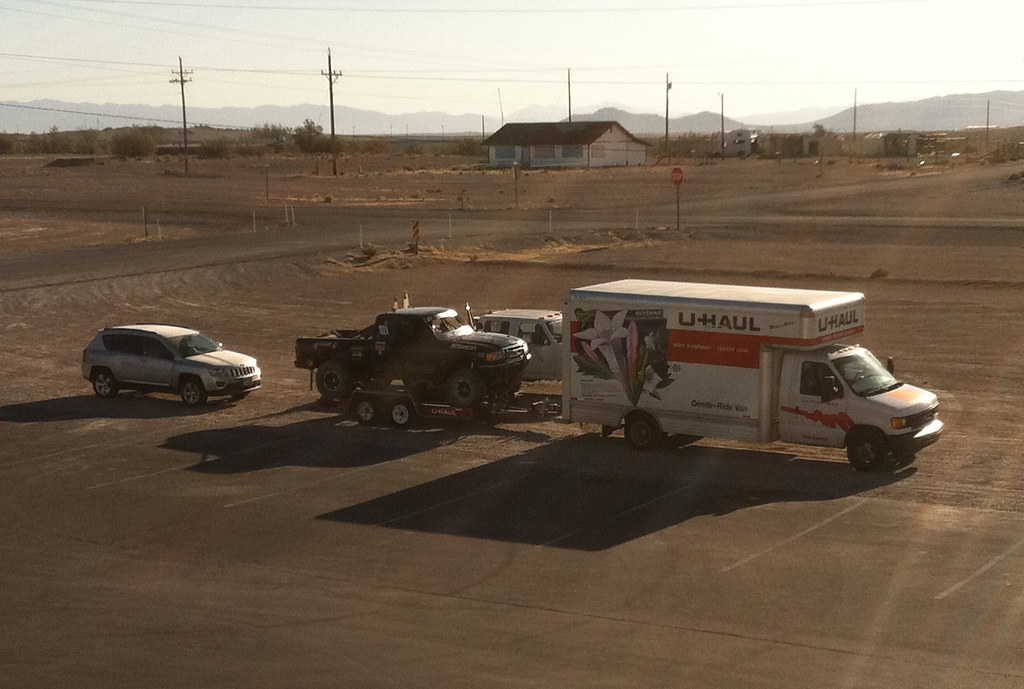
The view from the front of the hotel

We arrived at the start around 10:40. Steve and Scott suited up, you could tell they were fighting off some jitters. Steve wedged Bacon in the truck's roll cage, the dinosaur had already voiced his intent to iron man the race. John and Doug did a final systems check, making sure all the electronics were working and everything looked good under the hood. Steve and Scott climbed in, did their belts, and headed for the start. Less than ten minutes later (sooner than we expected) we could hear the V6 whine as the truck went off the start. We were racing. We packed the gear and headed for pit 1, located at race mile 33.
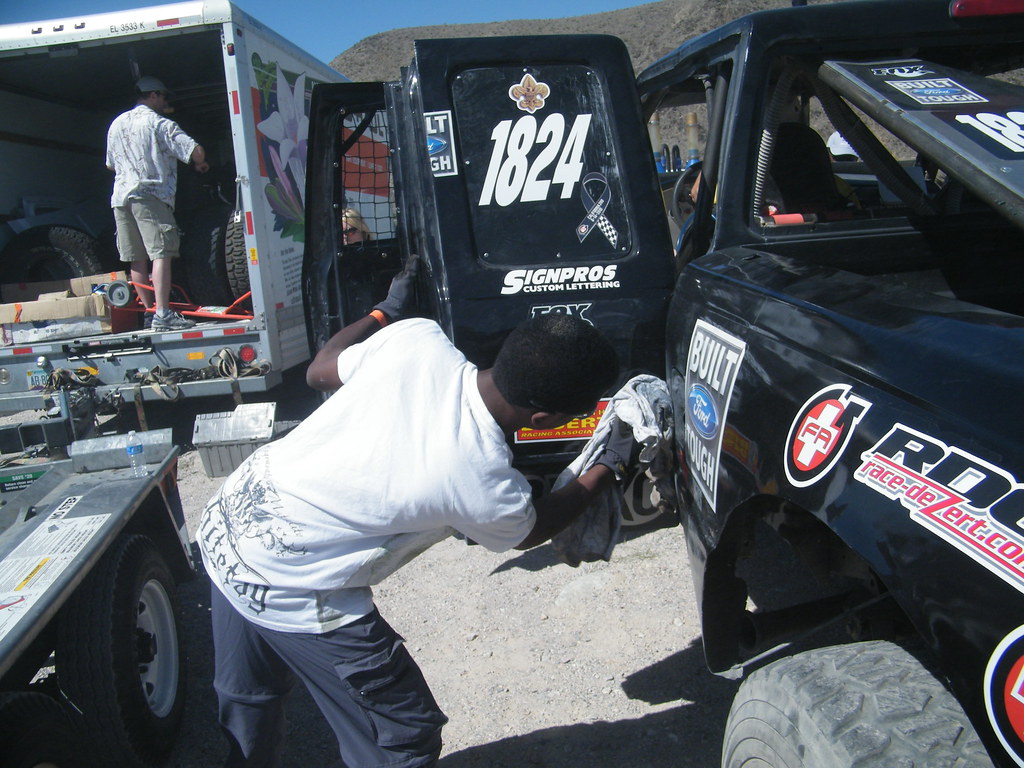
 Ellias gives the truck a quick cleaning before the start

We got to the first pit and set up. This was just going to be a quick preliminary stop to make sure Steve and Scott were good in the truck and everything was working properly. About an hour after we arrived (which felt like a day), the radio crackled. "1824 race, mile 30. Everything's good, we're coming in." Listening, we could hear the buzz of the engine. Soon the truck came into view, dropping off the crest across from us and rolling down the hill toward the pit entrance. Steve and Scott pulled in grinning and repeatedly using the word "awesome." They were in love with the ride already. Wanting to be thorough, Doug and John pulled the hood, which turned out to be a very good thing. A plug had come loose and was rubbing on the belt, wearing through it. The duo expertly did a belt swap and 15 minutes later the the truck was back on course. Load everything back up and on to pit 3 at mile 99.

Just to be safe we headed to pit 2 first, at mile 58, but as we were arriving we heard "1824 race, mile 65. They'd hauled butt and beat us to the pit. We turned it around and headed for 3. Pit 3 was a fun location because you could see the cars, at first only dust plumes like ground borne comets, descend out of the mountains (part of the Gold Peak mountain range), and run an arrow straight six mile stretch to the pits. Through the open plain we could hear the cars long before we could tell any kind of shape, or even tell there was a car at the head of that plume. As car after car went by we waited to hear from them on the radio.

A car on the road to pit 3

Suddenly Ron sat up slightly, pointing to a plume and saying "that one sounds like them." As if on cue the radio came to life. "1824 race, mile 95." We got the fuel cans out, this would be the first fuel stop. The truck hit pit entrance and slowed to the pit speed limit (or Steve's best guess thereof), crawling to where we stood waiting. They pulled in and shut off the truck. Taking off their helmets they jabbered excitedly about the mountains they had just driven over. As they went off to visit the port-a-john, we went to work refueling the truck and checking to make sure everything was intact. Upon removing the hood we once again found a minor problem, this time a cracked coolant hose. Like the belt we swapped it out and once again sent the truck out after a 15 minute pit stop.

The next stop was to be at pit 4, but we knew it would be a good two hours before the truck made it to the pit, since it was at mile 159. Fortunately the pit was on the outskirts of Goldfield, an old former mining town and the first sign of civilization we'd seen since the start at Beatty. We stopped in Goldfield for lunch and found a town frozen in time. The town hall and court house sat on the north side, with a large stone marker telling the history of Goldfield and how it became a boomtown shortly after the turn of the 20th century. Across the street was the fire house, built around the time of said population boom. Some of the original fire apparatus stood out front. A few blocks away was a house made entirely of stucco and beer bottles, built due to desperate need for materials, now a tourist stop. We made a lap up and down the street, taking it all in, then going to the Dusty Fender for food (the only restaurant in town). The place was small but the food was good and we enjoyed the relaxation.

Filled up, we went to the pit, located just northeast of town and right next to the boomtown-era graveyard. Doug and John got their safety gear on and prepared for their turn in the truck. "1824 race, mile 155." They were coming in. We suffered through the seemingly eternal final wait, wondering each time if the dust cloud over the rise is them, until finally the truck popped over the crest and into view. Steve and Scott pulled into the pit and got out of the truck, their minds still at race speed. The exhilaration they were feeling was overflowing and contagious. We found ourselves smiling and at ease as we did the driver change. Nothing wrong under the hood this time, so we were able to send the truck out in less than ten minutes, even with the driver change. Despite having just spent more than 5 hours in a black truck in triple digit heat wearing helmets and firesuits while traversing violently rough terrain, the duo looked fresher than the rest of us, the reason for which was shortly made clear when Scott declared the Parker Pumper to be the greatest racing invention ever. With the next pit just up the road for us, but 32 miles away for Doug and John, we sat for over a half hour as Steve and Scott regaled us with stories, trying to wind themselves down.

Eventually we got on the road and headed to pit 5 at race mile 191. Due to a low overpass between pits 4 and 5 (in a wash under the state highway) this was the earliest pit at which we could attach the light bar, so despite the new driver rotation this was still a mandatory pit location for us. We positioned the fuel cans and the light bar at the back of the truck, ready to go as soon as the race truck arrived. An hour went by and there was no sign of them. We were beginning to worry. Then we heard BFG Relay on our frequency, trying to call the race truck. We responded, identifying ourselves as 1824 chase. They informed us they'd gotten a call from the truck saying they were stopped at mile 172 with a broken tie rod and broken upper and lower ball joints on the passenger side wheel. This was not what we wanted to hear. We pulled out the maps and looked up the location. They were just after the low overpass. Doug's truck was the one with the radio, so we put a set of spare upper and lower control arms in the bed and headed for the overpass.

Arriving at the overpass we stared out into the desert and could just barely make out the unnatural shape of the truck, stranded in the desert. Now we had to find a way to get the arms to the truck. Only race vehicles and official vehicles are allowed to go out in the desert, and only driver/co-driver are allowed to work on the truck outside the pits, so we needed another race car or an official. Having no luck reaching Best in the Desert on the radio, we headed down the road. There was supposedly an alternate route with a BITD flagman for vehicles that were too tall for the 7 foot overpass, so if we could find it, maybe we could get help from the flagman. We saw a dirt road opening that looked promising and turned into it. Unfortunately it proved to be nothing but the driveway for a construction company. At that very moment, however, a Best in the Desert official truck drove by. Recognizing us as a chase truck, he stopped and turned around to see if we needed assistance. We explained the situation and he agreed to take the arms out to the race truck. Elated we tossed them in the back of his truck and watched as he drove out to deliver them. Maybe we weren't done after all.
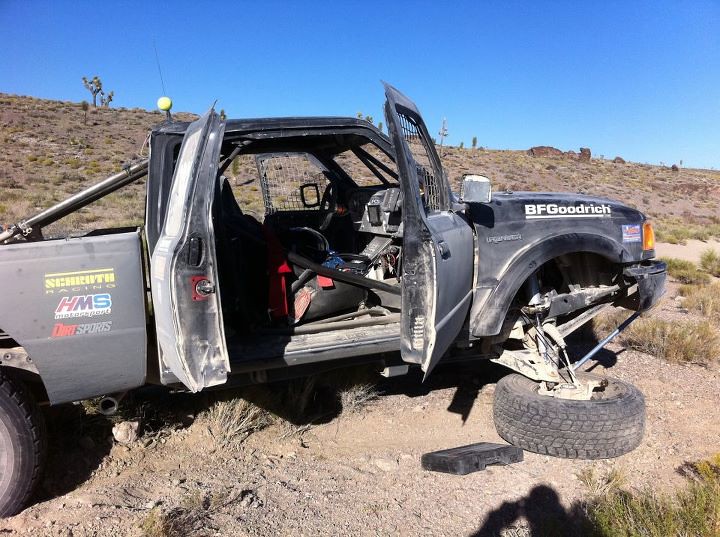
The broken truck, photo courtesy of John
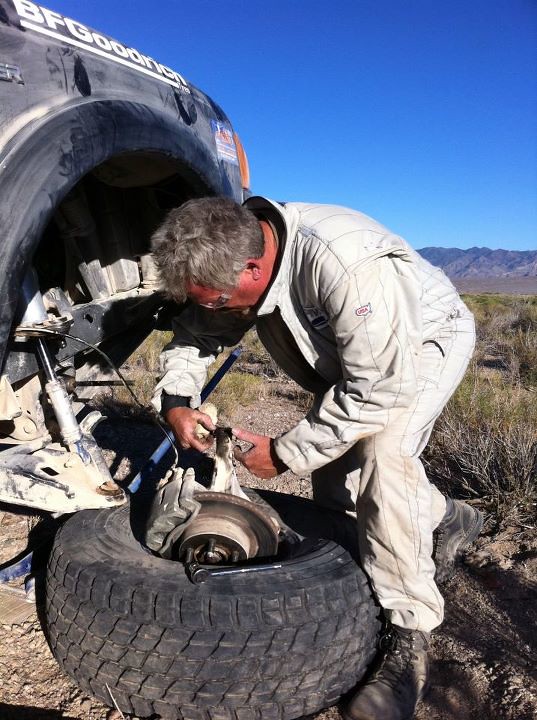
 Doug working to repair the truck

The arms went out and we waited as patiently as we could to hear word back. After a half hour or so it came. "The lower control arm is for the wrong side." Crap. Fortunately we had brought both lowers, just in case. Unfortunately there was no sign of a race vehicle or official to help us this time. Not ready to give up, Scott scavenged a ratchet strap from the bed of the chase truck, strapped the control arm (which weighs at least 20 lbs) to his back, and ran (or did his best attempt at running) the mile through the silt to deliver the arm. In that heat I thought he was either mad or secretly Superman. Turns out he's both. With the arm delivered it was now a waiting game.
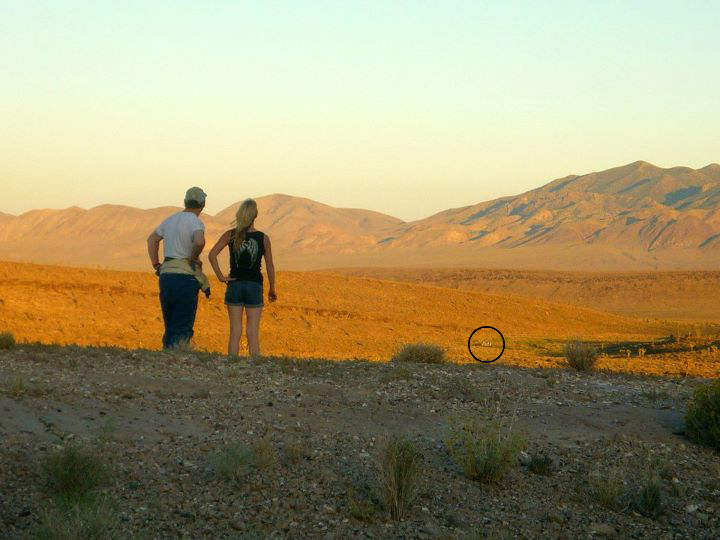
 Scott and Riley stare helplessly out at the race truck (circled)

Time dragged by and the sun began dropping. As it began dropping behind the mountains John came back on the radio. Between complications with the repairs and the fact that the truck didn't have the light bar there was no way they'd be able to make it to pit 5 before closing time. This was the end. The new plan was for Doug and John to fix the truck, drive it back to the road, and load it up on the trailer. The effect of the news was instant and intense. Suddenly we all felt tired, worn down. There was nothing we wanted more than to just pack it in and go. Hours crawled by. The jack Doug and John had stopped working, so we had to throw a spare into the bed of another race truck, one desperately chasing the pit closing time. We waited what felt like an eternity then, finally, headlights in the desert heading our way. With only some of the right tools and sheer determination Doug and John had fixed the truck.

We loaded up and drove back to Goldfield to organize ourselves, standing in a deserted parking lot under a lone street light with the hour approaching midnight. For Doug continuing to Reno meant going further from home than he needed to, so he decided to head back toward California. With most of us having booked flights out of Reno, the rest of us needed to continue north toward the finish. Steve, who was probably feeling more frustrated and dejected than the rest of us, wanted to push and do the full 5 hour drive to our scheduled Reno hotel. The rest of us, knowing we were too tired to make it, talked him into getting rooms at the nearest hotel. Steven agreed, but told us he doubted Tonopah (only a half hour away) probably wouldn't have any vacancies and we'd have to go to Hawthorne (over 2 hours away) to find a room. We reached Tonopah and sure enough every room was booked, including the Clown Motel (good news for Steve as his phobia was starting to show). After checking every hotel and motel we filled the gas tanks and began the push for Hawthorne.

Ironically, it was Steve who surrendered first. He called back saying he was beginning to get the "long blink," dangerous under any circumstance, terrifying with nearly 50 feet of box truck and trailer. We found a dirt lot at an intersection and bedded down for the night, Steven opting to sleep on the shelf in the back of the U-Haul. We rested for about four hours, then got back on the road to Hawthorne, found a room at El Capitan, and went back to sleep. Yep, we were tired.

We finally woke up around noon. First thing we did was take turns showering, getting 24 hours of desert off of us. Steve and Scott probably clogged the drain. Refreshed, clean, and having had time to absorb the previous day, we headed for Reno feeling much better. That night after the award ceremony we sat in the hotel restaurant, trading stories of this race, other races, and various other experiences and adventures. Even John, who signed on less than a month in advance with the intent to drive but ended up co-driving 12 miles then wound up stuck in the desert for 5 hours fixing the truck got into telling stories of the day, explaining how he and Doug had donned warrior headbands while doing repairs. Every one of us agreed, despite it all and in fact because of it all we'd had a great time. It was there in the restaurant as we reflected upon the week that we realized while we may not have finished the race and it may have been a success from a competitive standpoint, we had an adventure most can only dream of and stories we'll be telling all our lives. And that was the greatest victory of all.

Some of the crew, in Reno at last

See Steve and Ron's (and the event photographer's) photos here: Flickr Photo Gallery
See the team photos here: Facebook Photo Gallery

Tuesday, August 9, 2011

Crew 35 Update: Vegas to Reno 2011

Ok, folks. Here's a quick status update. Around New Year's we discovered our roll cage had some design issues which, as a result, meant the entire cage needed to be completely rebuilt. This was a bit of a wake up call, as it caused us to realize we would have failed tech if we'd brought the truck out to race in '09. Massachusetts to Nevada is too costly of a tow to fail tech, so it was decided we had to make sure the truck we build is certain to pass tech and prove itself in the race. To guarantee this, the adult leaders got together in March and began pooling their resources and saving their money to buy a well built and highly successful class 7300 Ford Ranger (one that also comes with an abundance of spare parts). The truck will be brought back to Massachusetts and used as a template for the Venture Crew 35 Ranger.

Next week, August 16-22, Crew 35 is going out to Las Vegas for the truck. We are going to run it in this year's Vegas to Reno desert race, competing in the sportsman class (a "run what you brung," no points, no payout, purely for fun class) before bringing it home. This race is our training run to learn what to do, what not to do, and what it will take to successfully run this race with the Crew 35 Ranger.

We will be posting updates when possible via Facebook and Twitter. There will also be a link on Race-Dezert.com where you will be able to track us and all vehicles competing in the Vegas To Reno race. This link will likely show up on the page either the evening before or the morning of the race. The Race-Dezert Vegas to Reno page will have live satellite tracking, timing and scoring, and occasional text, audio, and video updates. Our truck is number 1824 in the sportsman class (class 1800).

Thursday, December 2, 2010

2010 In Review

What to say about 2010. It's been a heck of a year, full of disappointment and excitement (and a blog that has been neglected far longer than it should have). When it comes to the truck, there was a lot of frustration and disappointment. On three separate occasions we thought we had a new shop lined up, but a week or two before the scheduled move things got in the way and the truck ended up staying where it was, in the advisor's garage, not being worked on. We weren't able to move it until August. Fortunately since then things have picked up. We've been able to work on the truck a couple times since then, and we're about to move to another shop (owned by the father of one of Troop 35's scouts) where we'll be able to work on it even more often. It still isn't running, unfortunately, but we're going to work our butts off to change that. As for the rest of the year, it was filled with fun and adventure. We saw new places, met new faces, learned new skills, and made new friends. So here's a review of 2010, starting from where we left off with the last blog post.

2010 was the year of rally. We knew we couldn't afford to go west this year, so we chose to go to multiple races in the northeast. Rally is the closest thing we have to desert racing up here, so this was our focus. None of us had ever been to a rally race before, even our advisors. We knew for the most part how rally races work, and some of us even knew the key players, but beyond that it was completely new. And that's how we started.

Our first race was the Team O'Neil Rally in Dalton, NH. This was the perfect starter race. Single day event, close to home, and as a regional event (as opposed to national) there were fewer spectators, meaning travel during the event was easier and finding a good place to watch the race was no problem. There were three major spectator points, and through careful scheduling and planning, we were able to hit all three of them during the day. This was one of the things I loved about rally. Even as a spectator you're busy. You need to sit down with a map and a schedule, plan your routes and times during the day, and figure out the best strategy for seeing the most action. All this extra involvement makes you feel like you're more than just a witness to the sport but in fact a part of the sport.

The 19 car field field at Team O'Neil was mostly Subarus, as one would expect, but also included a biodiesel VW Golf and a Jeep Comanche pickup with a Dukes of Hazzard dixie horn. Most of the stages took place on the roads of the Team O'Neil Rally School (an incredible complex), with the remaining few on the roads near the facility. New to the adventure of rally, we started the day at Parc Expose (a chance to see the cars and drivers before the event), arriving well in advance and in fact beating most of the race cars there.

A few of the rally cars in front of Dalton Town Hall

In all we got to see 8 stages from 3 viewing points before going to the awards dinner nearby. By the time of the awards we were already hooked. The speed, the precision, the control, the sound of turbos chirping through the forest, the way the drivers were able to slide cars around the corners, as if the wheels were on sideways, it was an amazing spectacle. This wasn't driving. This was art. One couldn't help but be both invigorated and entranced by it all. On the way from the final stage to the awards dinner we ended up in convoy with four of the rally cars (rally cars are street legal, license plates and all). Being in the middle of these machines sealed the deal.


At the dinner we got to see the human side of rallying. Everyone we met, be them driver, crew, fan, or even the people in charge of the race, were willing to take the time to talk to us and make us feel welcome. We got to stand in the front of the (admittedly small) crowd during the champagne spray, and during the awards dinner we sat with the team of Joey Kale and codriver Scott Nickerson. During the dinner we found out Scott had been a scout as well (scouts are everywhere). He shared the video footage from the car's onboard camera with us, allowing us to copy it to my computer (at least until the camera battery ran out). Dinner was excellent and we had a blast chatting and listening to stories. Rally rocks!

The winners of Team O'Neil celebrate

In between Team O'Neil Rally and Susquehannock Trail Performance Rally (which wasn't originally on our schedule), we had our usual booth at the World's Largest Pancake Breakfast here in Springfield. The breakfast is an annual tradition, celebrating the birthday of the city. We've been at the breakfast for years, promoting the values of scouting. This year we decided to make things more interesting with a new fund raiser. We had Ellias, one of our crew members, stand on a stool in front of a plywood wall. For a dollar, a patron at the breakfast would get a piece of Gorilla Tape and use it to secure our scout to the wall. After 90 minutes we pulled the stool, seeing if there was enough tape to stick the scout to the wall. It was a great fund raiser, very popular with the kids at the breakfast, and we were able to raise $100 for the crew. Also, he did stick.


The decorations are the result of a passing clown

Our next trip and quite possibly our biggest event of the year came in July with the New England Forest Rally in Bethel, Maine. Unfortunately most of the scouts have summer jobs, so only three of us could go. Fortunately, however, because all three of us were over 18 we were able to volunteer to work as course marshals for the rally. For the most part being a marshal simply means going out on the stages and making sure nothing happens that could put spectators or racers in danger. Going into more detail it meant we could go beyond the realm of spectators, from getting to be out on the shakedown stage to going to the awards dinner (for free) at the end of the event.

We pulled into Bethel Thursday afternoon, made camp at the nearby Stony Brook Campground (which was an excellent facility), and headed over to Sunday River Ski Resort, the base of operations for the rally. After signing in (and getting some sweet volunteer swag) we were told we could drive down to the shakedown stage and find a place to watch the cars. Shakedown is a sort of pre-race practice, typically held the day before the race, where drivers can give their cars a final check and sort of warm up their skills. We parked on the inside of a hairpin and walked about a half mile down the course, choosing to watch at a sort of "S" bend near the stage start.

Crew members Adam and Jake watch as rally star Ken Block flies past on shakedown

After about an hour on shakedown we decided to head back towards our car, stopping at a few other viewing points to watch the race cars go by. Upon returning to the hairpin we discovered I had left the van windows open, which resulted in the entire interior being coated in a fine layer of rally dust. Oops.


Its the blue van in this video. You can see how it ended up so dusty

After shakedown we headed over to the Phoenix Lodge for dinner. At the lodge we ran into rally driver Bill Caswell, a former Boy Scout himself. We ended up having dinner with Bill, sharing stories of rally, desert, and scouting. During dinner he revealed his plans to race a modified BMW E30 at the Baja 1000, a story we had to keep to ourselves until late October. We ended up hanging out with Bill until nearly 1AM, finally retiring to camp to get some rest before our early wake up for the race.

Between the two days of racing we marshaled a total of five rally stages, having the time of our lives at every one. The top tier drivers at this event were unbelievable, able to make their cars do things that physics says should be impossible, reaching absurd speeds over narrow, challenging roads. Once again we left with new friends and a plethora of stories. And some awesome photos.

Joseph Burke goes by on Stage 7. That's Adam in the white shirt and orange vest

Unfortunately plans to go to National Jamboree with the truck more or less fell through. Still being unable to find a place to work on it meant it wasn't ready to go to the Jam. A few of us went down for a day anyway, just to experience it. Despite the trip being challenging, involving a missed train, an 8 hour overnight drive on little sleep, and lost hotel reservations, being at the Jamboree more than made up for it. Jambo was incredible and its a shame the centennial celebration of the Boy Scouts of America can't go on another year.

In August things finally picked up. We moved into a new shop and returned to work on the truck. A few days after the move we went to the AMA Motocross race in Southwick, MA. This has always been a good fund raiser for us. We work in the pits for the track during the race, and in return the track pays the Crew for our services. We also get to talk to the riders during the day, and some riders donate jerseys for us to auction off for the project. This year Matt Goerke and Dan Reardon donated their jerseys to us. We intended to have them up on ebay in September, but decided to delay the auctions when we got big news.

Toward the end of September we got an email from Boys' Life magazine saying they were going to feature us in the "Scouting Around" section of the magazine. Naturally this was a very exciting moment for us, as well as a nervous one. Suddenly our little project was about to go out nationwide, and in Boys' Life at that. We emailed back and forth with the magazine, giving them info about the project and doing a photo shoot with the truck so there were new photos for the article. The article will be in the January 2011 issue of Boys' Life

A photo from the photo shoot, during our practice pit stop drill

Our final race trip of the year took place on the first weekend in November as we went down to the RallyCar series Rallycross race at New Jersey Motorsports Park in Millville, NJ. Despite having many of the rally drivers and cars we had come to know during the year, this race was completely different. Instead of dirt roads and logging trails through the woods, the Rallycross race took place on a half asphalt, half dirt circuit, built on one of the tracks at NJMP. Races were side-by-side between four to six cars, with each race being four laps long. The Rallycross event brought in legendary drivers from both the United States and Europe, including Travis Pastrana, Dave Mirra, Pikes Peak record holder Rhys Millen, Top Gear USA host Tanner Foust, Sverre Isachsen, Toomas Heikkinen, Andrew Comrie-Picard, Liam Doran, and Nitro Circus sponsored driver Matthew Johnson, who schooled the 2WD class in a 70's Ford Fairmont station wagon.

This car is INSANE

All the drivers and teams were incredibly welcoming (as is apparently the norm in rally/rallycross). Travis Pastrana recognized Steve from the New England Forest Rally and we chatted for a bit about what had gone on since then (Travis, you still owe us some Baja stories, buddy). Andrew Comrie-Picard (ACP) talked to us for well over a half hour (he also signed the back bumper from his car and gave it to us at the end of the weekend). Ellias got to talk to Rhys Millen about how to get started in drifting (Rhys is also a champion drift racer). Matthew Johnson brought a strange bike called a "swing bike" and let anyone brave enough ride it around the pits. A swing bike has an extra hinge on the frame beneath the seat. It is simultaneously thrilling and terrifying. We want one.

This is how you ride a swing bike

Racing at the Rallycross was thrilling. We were parked right by one of the tightest turns on the course, which was also the location of the jump, so we got to see lots of sideways action and big air. The drivers gave everything they had, this was the last race of the season after all. In the end the Euro drivers won both days, with Tanner Foust being the highest finishing American. At the end of it all the Subaru Rally Team drivers celebrated by giving the crowd an excellent smoke show.


All in all it's been an amazing year. While we didn't get the chance to visit the desert and come home with sand in our shorts we did get to see a whole new type of racing and make so many new friends. We love the desert, but there's no denying the awesomeness of rally. We're making plans to work with rally teams next year to get more pit experience before we go out to Nevada. Meanwhile we're hard at work on the truck to get it finished and tested. With the racing off season now upon us we hope to put more hours into the build. Anyway, until next time, farewell from Venture Crew 35.

Friday, March 19, 2010

Crew 35 Plans for 2010

We were so sure we'd have the truck at the 2009 Vegas to Reno that we even sent in our registration fee to Best In The Desert. Failing to make the race hurt like you wouldn't believe. Even worse, we also lost our chief fabricator/desert racing expert. While it's relatively easy to find a new desert guru in the southwest, such experts are few and far between here. Losing him made things tough and, for all practical purposes, put the build on hold. We also lost some of our scouts. Put all this together and as a result we found ourselves in a sort of rebuild phase. We had to take a step back, regroup, and restrategize.

Finally, after much work and much contemplation, we decided upon a schedule for the 2010 season. For those unaware, 2010 is the 100th anniversary of the Boy Scouts of America. As part of the 2010 celebration, the BSA is holding a centennial jamboree this summer that is sure to be like no other jamboree in history. Tens of thousands of scouts, countless thousands of visitors. This will be massive. Naturally, there's no way we could pass something like this up. After all, it's not like we can just wait and go to the next centennial jam.

Unfortunately, by going to Jamboree we have to sit out the 2010 Vegas to Reno. This was a painful and difficult decision to race. We said we could do this. We said we would do this. We want to prove we're more than just talk. So this decision was a difficult one. But it had to be made. Most of our kids can't afford to go to both Jamboree and V2R in the same year, the funds just aren't there. And the same goes for the Crew itself.

So when will the truck race? The answer is 2011. We've worked hard to get there, and we're saying definitively that '11 will be the year we race. The plan at present is to race the 2011 Vegas to Reno race. However, we've heard Best In The Desert racing series has a special race planned for 2011. They're saying it will be big and unlike any other race inside the U.S. As we've already proven, we like big and we like different. So depending on just what this race is and what time of the year it is (it needs to coincide with Crew members' school schedules), we may choose that race instead. But Venture Crew 35 WILL run one of these two Best In The Desert series races in 2011.

Plans for the truck: We will have the truck at least driving properly by late fall at the latest. Once it's driving we will use all available time to fine tune it and make it as good as possible. Shock valving, engine/suspension tweaking, finding weak spots and strengthening them, etc. We're only running one race in 2011 so we want to maximize our chances of finishing and (dare we say it?) winning. So we'll put as many miles and hours of testing into it as we can. In addition, we will take advantage of every available opportunity to show off the truck. This includes car shows, parades, and The Big E, a 16 day long fair that brings in over a million visitors every year (the 2009 attendance was 1,260,487, an average of 79 thousand people every day).

We may not be racing the Crew 35 truck in 2010, but that doesn't mean we won't be at the races this year. We will be attending select races and motorsports events here in the northeast, primarily as spectators. The Crew is currently discussing and voting on some of our races, but we can announce for certain that we will be at the Rally America New England Forest Rally in Maine and the AMA Motocross race in Southwick, MA.

Those are the plans for Crew 35. We're excited for what is to come and look forward to Jambo this year and racing next year. We would like to thank all our sponsors and supporters who have stuck with us and helped us get where we are now, without you we would have never gotten beyond the "dream" phase; BFGoodrich, Aero-Tech Services, American Racing Wheels, MasterCraft Seats, Schroth Racing, HMS Motorsport, Bilstein Shocks, HalRay Synthetics/AMSOIL, the Dezert People Video Series, K&N Filters, Frozen Rotors, Speedway Expo, Speedlox, Longacre, Rory's Off Road, Clayton Off Road, and last, but certainly not least, all the incredible people at Race-Dezert.com. Thank you all!


2010 EVENT SCHEDULE (Confirmed Events in Black. Possible Events in Red. More Events to Come):


May 8, 2010: Team O'Neil Rally, Dalton, NH
May 15, 2010: World's Largest Pancake Breakfast, Springfield, MA
May 21-23, 2010: Western Mass Council BSA Adventure 2010, Amherst, MA
June 19-20, 2010: Burke Mtn Hillclimb, East Burke, VT
July 15-17, 2010: Rally America New England Forest Rally, Bethel, ME
July 26-August 4, 2010: Boy Scout National Jamboree, Fort A.P. Hill, VA
August 28, 2010: AMA Motocross Southwick, Southwick, MA
September 17-October 3, 2010: The Big E, West Springfield, MA
October 16-17, 2010: Mt Philo Hillclimb, Charlotte, VT

Tuesday, November 17, 2009

Special Blog: Being a First Time Co-Driver

In this blog, adult leader Steven Harrell will describe what it's like being a co-driver, and his experiences, stories, and thoughts after his first time in a race truck.


I went out to Vegas for the Vegas to Reno race excited and more than a little afraid. I came back tired, sore, immensely dirty, and completely in love. Riding in that race truck was one of the most exhausting, stressful, labor intensive, and without a doubt fun things I've ever done. And I can't wait to go back.

I admit, I underestimated the duties of a co-dog. I thought it was a much simpler and less stressful job. It was during contingency/inspection that I was first introduced to just how difficult the co-dog life is. The Rumble Goat Racing team had me sit in the seat, try putting on the belts (while reminding me that on race day I'd be doing this wearing a helmet and Nomex gloves), and introduced me to my jobs. All SEVEN of them. I would have to check the mirror for any faster traffic behind us (because failing to notice a faster car in time results in getting run into), check the gauges to make sure nothing is overheating, watch the GPS and let the driver know what was coming up ahead in terms of corners (or dangers. Or road crossings.), hit the horn/siren any time we came up on someone slower than us , use the radio to report our mileage and status to the chase crew, read the upcoming danger sections on the clip board so the driver knew what to expect, and keep an eye on the course itself to call out any rocks, mile markers, danger signs, or hitch-hiking aliens the driver might not see.

Learning how much more I had to do completely changed the rest of the day for me. I kept going over it all in my head. All I could think about was what I needed to do and how not to screw it up. I had some serious butterfly action going on in my stomach. Nervous as hell.


Day 1 course map. Click Here to see a larger version of the map.

I was scheduled to co-drive second shift on day 1, starting at Pit 4 at mile 161 and going to the day's finish at mile 332. Waking up early to get to the start and chasing throughout most of the daylight hours with the scouts distracted me and had me feeling better. Then after servicing the truck at Pit 3 I was told to suit up and get ready. The butterflies were back. And they brought friends.

We knew from the radio call-ins that the truck was getting close. The co-driver calls out every race mile on the radio, so we could hear it getting closer. "Truck 7302, race mile 158"... "7302, race mile 159"... "7302, race mile 160"... Finally a bit before 5 PM (a full six hours after the truck had left the line) the silver RGR truck appeared. As it pulled into the pit my heart was going a mile a minute. I waited for the first shift co-driver to get out, then began the process of getting in, as it had been taught to me the day before. Loosen all five belts. Climb in. Attach the belts. Tighten the belts. Plug in radio. Put on neck brace. Put on gloves. One of the crew members checked my belts and the radio to make sure I was secure, closed the door, and I was off. "7302, race mile 162."


Loosening the belts before climbing in.

Giving a thumbs up as I begin my first ride.

Pretty much immediately after leaving the pit there was a 3 mile blast across a dry lake bed. This is where we came across our first problem. I radio in "7302, race mile 163." I hear a faint buzzing. Jose (the driver) kinda turns toward me and says "Aren't you going to respond?" "Respond to what?" I ask. Turns out that although I can hear Jose fine, and the chase crew can hear me fine, I can't hear the chase crew. Jose can, but he's too busy operating the round thing in front of him and keeping us from falling off cliffs to do the radio communication stuff as well. So we come up with a system. When the chase crew says something, Jose repeats it, and I call back the response. It wasn't a great system, but it did the job.

Once we got the radio thing sorted out we found a second problem. When the previous co-driver got out, the clipboard full of danger areas went with him. The clipboard has every danger on the course listed, along with its mileage and what the danger is. Without the board there were only two ways to let the driver know of an upcoming danger. If the danger was listed on the GPS file (only about half were), I could call it out when it appeared on the screen (maybe 1/2 mile before we reached it). Dangers not listed on the GPS file were still marked by small orange signs on the course only a few hundred feet before the danger. Keeping an eye on the course was now even more important.


An example of a danger sign. Imagine trying to spot one of these while doing 40+ mph. While your eyes are being bounced out of your head.

Despite the initial issues, driver Jose proved to be a great teacher and within a half hour I'd gotten into the grove of co-driving. The trail itself was my primary focus. I had to watch for the mile markers, danger signs and rocks. Anything the driver might have missed. After that, it was the GPS (a 5 inch screen mounted about where the stereo and AC controls used to be). This was my tool for telling the driver how soon the next corner was, how long/sharp of a corner it would be, and if there were any GPS marked dangers coming up. At the zoom level it was set to, I usually had at most 10 seconds to let the driver know what was coming. Frustratingly, there were some sections where the road did a back and forth weave that was too tight to show up on the GPS. For these I was as surprised as the driver.

A few of the gauges had been reading worryingly high during the first shift, so I'd been told to keep an eye on them. This is much more difficult than it sounds. Take the Trans Temp gauge for example. There was a line on the gauge at the 250 mark. If the needle was just below it (say 248), that was ok. If the needle was above it (252), that was bad and should be called in. On a 2" diameter gauge this is hard no matter what. It's a million times worse when you're sitting in the world's largest paint shaker. This really was a difficult job.


Try reading these while jumping up and down

They had told me during inspection that the mirror would require my attention often. Fortunately by the time I got in, the field had spread out and for the entire duration of the shift only a few trucks passed us. All the same I made sure I looked in it at least every mile to ensure we weren't about to be run over.

The scenery on the race course was much more interesting than the scenery from the road. On the highway it's generally flat, smooth, and empty aside from the occasional building or "town" every 15 miles or so (and I use the term "town" loosely). You see mountains but they're a few miles to each side. On the race course we ran over, around, and through those mountains. Sometimes we'd have vertical walls of rock on each side, giving us a narrow canyon between them, other times we'd come around a blind corner and find ourselves on a winding, one-lane-wide trail with a 50+ foot vertical drop on the side. On a few occasions we would crest a mountain, and at that peak it would seem like we could see forever. Miles ahead we could see a dozen columns of dust rising off the ground, marking the locations of other trucks. It was surreal.


Example of a dust trail

When you're in a multi-layer firesuit in a race truck in the middle of the desert during 100°+ conditions, staying hydrated is critical. There were at least a dozen bottles of water inside my door. When thirsty we would unscrew the cap, stick the bottle up underneath the dirt skirt on the helmet and up under the front of the helmet. Since tilting one's head back in a helmet is nigh impossible, we had to rely on squeezing the bottle to get the water to the waiting mouth. I learned quickly that this made a mess, particularly if the bottle was more that 3/4 full.

Unfortunately, we weren't the only ones suffering in the heat. The truck had been vaporlocking all day. The hood had been removed back at pit 3, which helped, but even with the hood off the truck stalled and died a few times during the daylight hours. When it did all we could do was sit and wait a few minutes then try to start it again. It was frustrating and killed momentum, but relatively minor as far as issues go.

Not too long before reaching Pit 5 we had our first real mechanical problem during my shift. We rounded a fast corner and spotted a large pointed rock. Unfortunately it saw us first and made a bee line for our tires. We hit it and heard a bang. It was rather obvious what had happened. Jose pulled it over in the first clear space off course and I got out to take a look. All that was left on the rim were the two ragged, donut shaped flaps of rubber that had once been the sidewalls. The entire tread was gone. Jose got the jack and I got the breaker bar. In short order we got the wheel off, put on a fresh tire, and I was tightening the lug nuts I had just taken off. All the while promising Jose I'd give their team an impact wrench for Christmas. We secured the wheel in the truck's tire carrier, got back in the truck, and continued to pit 5. When we got there, the crew looked in the back, then came up to us and said "Hey, guys. Where's the wheel?" It had somehow fallen out.


Coming into Pit 5


If someone finds one of these in the desert with shredded rubber on it, let us know

We got rolling again and back in our groove, but Murphy wasn't done with us yet. We were bombing through a silt bed trying not to get stuck (slow + silt = stuck). The truck slammed into something in the silt and sent our front end skyward. We came down hard in an explosion of dust. Jose tried the gas to make sure the drivetrain was intact and the truck accelerated like nothing happened. We cleared the silt bed feeling like we'd dodged a bullet. Then I found myself saying "Do you smell burning rubber?" We pulled over. Again. I got out. Again. I circled the truck. No flats. But the stench of rubber was unmistakable. Something was wrong. I got on my hands and knees looking under the truck. I found the problem in the right front. The knuckle (aka spindle) had bent, causing the tire to lean inward so far that it was rubbing against the end of the upper A-Arm.


Not something you want bent

The RGR Ford Ranger is a 4 wheel drive truck. While this helps get through the rough stuff, it's bad news when you want to change a knuckle because in addition to everything else there's a drive shaft to deal with (unlike the diagram above). Jose informed me that the next pit would close in 30 minutes and the team had never changed one in under 45. And here it was just him and me. And I wasn't familiar with the truck. And the sun was going down. And every time another truck went by it made too much dust and we had to pause. We were in trouble. I was sure this was the end of the day for us. It felt over.

Jose, knowing much better what to do and how to do things, did most of the work while I acted as the parts fetcher, grabbing whatever he said he needed. We worked feverishly, always choosing running over walking when we had to go to the back of the truck for a part or a tool. The light faded with alarming speed, forcing us to break out the flashlight, which predictably decided not to work. We were forced to use the small light that had been attached in the cab so co-drivers could read the danger clipboard at night. A few stragglers passed us, their co-drivers often giving us a wave as they went by. Two or three stopped to ask if we were ok or if we needed anything. Camaraderie is strong in the desert.

By some divine miracle Jose got the knuckle replaced. We secured the damaged tire in the holder, put the tools in the cab, and threw the jack in the bed, not even taking the time to secure it properly. We had to go fast if we wanted to make it before the pit closed. Jose drove brilliantly and got us to Pit 7 both fast and without issue. I don't know if the BITD official was feeling charitable or if we were just lucky but we were told we made it with pretty much seconds to go. The chase crew swapped out the tire in the carrier and got all the tools and stuff secured properly. They inspected the repair job (along with the rest of the truck), and we were on our way.

It was now dark. And in the dark it was completely different. Anything either too far in front or too far to the side to be illuminated by the lights no longer existed. The world was now whatever the light touched. Every corner was now blind. The dust hanging in the air gave off an eerie, almost alien glow when the lights hit it. The desert had become a world of UFOs, and we were one of them.


The alien glow of a race truck

After four and a half hours I was starting to feel stiff. The joints in my legs were tightening up, the chin strap on my helmet pulled against my Adam's apple during rougher bounces, and the transmission was cooking my left foot through my driving shoe. On top of all this the forehead pad in my helmet had slipped and now the corner of the hard foam was digging into my scalp. It was like having my head pressed against the edge of a knife for an hour. I found myself starting to count down the miles till we finished.

Some time after 11 we pulled into a stop checkpoint (the race has checkpoints at undisclosed locations where you need to stop so they can record your number and the time you arrive. This is to make sure nobody shortcuts the course). The front facing number on the truck had been on the hood, which after the morning's vapor lock issues was on the trailer. The side numbers were completely coated in dust and unreadable. So the check official has to come up to my window and ask us the number. After this incident I'm going to make sure the Boy Scout truck has the number on the windshield visor.

The miles and the minutes passed slowly as my forehead began to hurt more, the hard foam edge cutting into it. I put as much focus on my duties and on the course as possible in an attempt to distract myself from the pain. We cleared the final pit at mile 302. Just 30 miles to go. I couldn't wait.

I caught a flash of orange in the lights. Extreme danger ahead. "Extreme danger. Back it down, back it down" I said to Jose. He backed it down to a crawl, and it was a good thing. Dead center on the course the lights lit up an enormous cement block. It was an old bridge pylon, a good eight feet wide, at least twenty long, and maybe three or so feet high. If we had hit that at speed, it would have ended more than just our race. We chuckled and drove carefully around it. I made a mental note to be sure to get that clipboard the next day.

Finally we hit the loop at the end of the day's stage. The loop was a 14 mile section on a wide, smooth, graded road. We rolled through this final section at a good clip, feeling confident and relieved. No more silt. No more rocks. Just this one stretch of road a minivan could probably navigate without too much trouble. We had no competitors near us so there was very little dust in the air in front of us. I was able to crack the visor on my helmet open about a half inch. Cool night air rushed in through the opening. It felt absolutely incredible. Like a cold drink after a long day of summer yardwork. It made that final loop so much easier to deal with.

Finally, after a good 20 minutes we exited the loop. One mile to go. We had already radioed the support crew and they were setting up in the work/repair area in Tonopah. I radioed in that we were at race mile 331. I'm sure the excitement was evident in my voice. We were a mere minute away from finishing.

The final mile was another smooth section. Halfway through I could see vehicle lights on the nearby highway. Finally, after hours of desert, we were returning to civilization. We crested a final small hill and there it was. The finish line. Elated I hit the horn as we approached. This was it. My first finish in a race truck. We'd done it. I'd done it. The feeling was indescribable. I was on top of the world. And happy to get my helmet off my head. I rode the mile from the stage finish to the work area with my helmet in my lap.

When I got out, my body acted like I'd spent nearly seven hours sitting in a truck. My legs were wobbly and it took a few steps for them to re-learn walking. My forehead was red and my Adam's apple hurt like hell. I was tired dirty and thirsty. And I couldn't care less. I was riding a high like nothing I'd ever felt before. Racing was a thrill. Finishing was divine. Even if it was just the day's stage.

I rejoined the scouts and drove us into town. We searched for food, finally grabbing some random items from a gas station, then searched for a place to pitch tent and sleep. Both Camp Adventure and the Camp Adventure overflow area were packed. We ended up on a hill on the outskirts of Camp Adventure. Exhausted, we put up the tent and fell asleep quickly. One day down. Two to go.


Day 2 course map. Click Here to see a larger version of the map.

I had originally thought I was going out first shift on day 2, but in the morning I was informed I'd be second shift. While I was initially disappointed by this because I wanted to see what it was like to run with the pack, it ended up being beneficial for me. It meant I wasn't in the truck when it got rolled onto its side (the passenger side at that). Somewhere between pits 2 and 3 it got rolled, damaging the steering rack. Replacing this rack guaranteed it would be another late finish for us.

I would be getting in this time at pit 5 (mile 540) and riding it to the day's finish at mile 699, a 159 mile journey. This time I would be riding with Jim. Whereas Jose was the better teacher, Jim was the better driver. Jim likes to go sideways whenever possible. And he's very good at it.

The truck arrived at pit 5 just after 7 pm. The sun was already beginning to get low in the sky. Finishing before the finish line closed was a very real concern. Despite this the Rumble Goat team was very methodical in their pit stop. Their movements were determined but not frantic. They knew what they had to do and they made sure they got it done right.

I once again climbed in and strapped myslef to my seat. Closing my door was a problem. Because of the rollover it no longer latched. Fortunately, the BITD rulebook anticipates that sort of problem and mandates a backup system. On this truck it was an old GM seat belt screwed to the door and doorframe. One of the crew members had to reach in the window and latch it. But it did the job well, keeping the door shut. We were about to leave and start day 2 when a crew member from Jeepspeed class truck 1736 came running over. Their truck had run out of gas between pits 5 and 6 and they wanted to know if we would take some fuel out to them. Naturally Jim agreed and the Jeepseed crew tied the fuel can down in the bed. Once everything was ready, the crew waved us out and we were on the road once again. It was time for day two.


The truck arrives


Climbing in for another day of fun


A crew member latches the door

Day 1 had been a course full of silt. It was obvious from the start of my shift that day 2 was going to be a day full of rocks. It seemed like every danger on the clipboard (which I had remembered this time) was rocks. Every ten miles or so there was another danger section labeled "Danger: Rocks" or "Danger: Big Rocks." Rocks kill tires. Flat tires kill momentum. Lack of momentum creates frustration.

The first 50 miles were routine and almost mundane. Mostly sweeping corners, fast straights, and slow sections where we were forced to crawl around rocks. The one thing that kept it interesting was the door damage. There was now a panel gap between the door and the fender. And in that gap I could actually see the ground through the body work. Somehow this amused me. We covered the 25 miles from pit 5 to pit 6 in about 50 minutes, which included stopping to give the Jeepspeed guys their fuel (the brotherhood of desert racing. Always help a fellow racer). I had remembered to ensure my forehead pad was in the right place, and most of the soreness was gone from day 1, so I was feeling good. We left pit 6 at 7:54 with the sun setting in front of us.


25 Miles down. You can see the damage to the door


Departing into the setting sun

Around 9 PM we hit mile 592 and the course became interesting, as it began a 20 mile run through a narrow mountain pass. A narrow mountain pass full of TREES. This was very foreign and strange compared to the over 200 miles I'd seen up to this point. I learned later that this section of the mountain was full of springs, making it rather lush and fertile.

The narrow pass was full of tight, blind corners. I had to work hard to keep Jim informed as to what was coming up, telling him the direction and the degrees of the next corner. "Left 90 into right 100 into right 30 into left 100..." After five miles of this we started catching a whiff of dust. It was clear we were closing in on something. Fortunately the wind in the narrow canyon blew the dust away enough for us to maintain visibility. "...Left 90 into left 90 into right 100..."

Over the next five miles we continued to close. At mile 602 we reached the highest point of the mountain pass, 8000 feet above sea level and 2700 feet above the beginning of the pass ten miles ago. As we crested this rise and began our decent we caught a glimpse of an amber light darting around a corner. We were closing in on the truck making dust. The chase was on.

Chasing another truck in a narrow canyon full of corners like that one is a blast. The walls of the pass were over 30 feet high on either side, meaning you could only see up to the next bend, which would sometimes be a distance of less than 200 feet. We would often round one bend just to see the truck dart around the next. This was both fun and useful, as it showed us where the next corner would be. As we closed I found myself straining to see what the truck was. I could tell it was a smaller pickup with four large lights on the roof. I knew it wasn't either of the other two stock trucks in our class and this excited me. We were running down a truck from a faster class.

The chase went on for miles. Always rounding a corner just to see the amber light of the other truck disappear around the next one. Both trucks charging down the mountain, gassing it on the short straights, braking hard into the corners. Finally, after a good seven miles of chasing, we got close enough for me to hit the horn. I pressed the button on the console and our truck's siren wailed. The other truck pulled to the side and we blew past. Another new experience for me. My first overtake. It wasn't going to be my last.

We exited the pass just before the next pit at mile 612. We were back down to 4700 feet. A 3300 foot drop over the course of ten miles, an even more extreme altitude change than our ascent had been. We pulled into the pit for another routine stop. The engine temp was a bit high, but not enough to make it an extended stop. After giving the truck a thorough look over, we were released back into the night.

Clear of the mountain pass it was back on the straighter roads. Unfortunately we weren't able to pick up any speed due to the constant rocks (which, ironically, had not been present in the pass). Fortunately around 10:30 or so the monotony was broken up by another shorter pass and what was almost certainly the strangest moment of the race.

We were running another narrow pass with steep sides and hard corners. I called them out as best i could based on the GPS and what I saw ahead of us. "Left 90, right 90, left 90, right 90, COW!!!! right 90..." We had rounded a blind right hander and there on the left edge of the course was a huge longhorn steer, his front legs actually on the course. As we passed we could see him stare at us, watching us go by with that "bored cow" look on his face, as if he didn't care about the truck passing two feet away from his head. Jim was cracking up in the driver's seat, laughing like a madman. "What?" I asked. "When did we get to Baja?" he replied. This got both of us laughing.

We cleared the cow and a road crossing and reached pit 8 sometime around 11 PM. This was our final stop and from here out we were on our own. It was a long 53 mile stretch to the finish, so the crew was thorough, making sure everything was set to go to the finish. The truck was starting to show some wear. It had been stalling out whenever Jim had to really get on the brakes. The voltage was down to the point where we ran with as many electronics off as possible, which included the gauge lights, the fans whenever possible, and even one of the two sets of lights on the front bumper during the faster, clearer sections. On top of this the water temp had been running between 240 and 255 throughout the entire shift (a change from the day before when it had been the tranny temp that was through the roof). Despite all this the crew was confident we could make it and they sent us out into the night one last time.

It was more rough going. Rocks. Washouts. Silt beds. Jim ran it careful but fast. We caught a buggy and another couple trucks (and ourselves got caught by a UTV, embarrassingly). Midnight came and went as we approached the finish. I wasn't in nearly as much pain, but all the same after 5 hours in the truck I was starting to get stiff. I wanted to get out, at least long enough to stretch my legs (a luxury that had been provided to me during day 1 thanks to the tire issues). I was counting down the miles. Less than 20 to go...

At race mile 690, we came across an insane sight. A massive field of boulders. Rocks littered the ground, some as big as five feet in diameter. Sitting in the middle of this mess, resting on one of these large boulders was a 7200 truck. The fiberglass was gone from both the front and rear and at first it looked like even some of the front suspension was gone. One of the drivers was laying on the back of the truck. The truck looked so bad that we actually stopped to ask if they were injured.


Fortunately they were ok and we moved past them. That's when we discovered there wasn't one stuck truck, but four. It was a graveyard. Trophy truck. Class 7200. Class 1100. Even a class 2000 that had rolled over trying to escape the rocky minefield. We made it through the field to the exit, a steep silt covered hill which seemed to exude menace. Jim stopped at the bottom of the hill and shifted the truck into low range before attempting to scale it. I could feel the eyes of all the stuck drivers on us, watching to see if we would become one of them. Even though it was a short hill, less than 200 feet, it felt like it took forever (and, seeing as we were doing about 1 mph tops, it kinda did). A few times I could feel the truck slide backwards as the silt shifted beneath the wheels, but finally we cleared the hill. Jim let out a yell, mentioned how awesome it was to have low range, and we descended out of the mountains into Hawthorne. After that hill, the final 9 miles felt like cake.

Just before the finish we caught up with truck 7330, one of the competitors in our class. 7330 had accidentally short cut the course, missing a full 33 miles between pits 4 and 5. To catch up to them even after this short cut was a huge thrill. Between scaling the impossible hill and passing 7330, we crossed the line around 12:30 AM feeling exhausted but elated. I once again joined the scouts for some gas station dinner before pitching tents again and going to sleep, with the lights of the Voss team's welders flickering off the canvas.


Day 3 course map. Click Here to see a larger version of the map.

Day 3 was my chance to finally start first shift in the truck. I'd imagined what it was like to see that light turn green and blast through that Red Bull arch, surrounded by the competition before they have a chance to spread out. Now I would finally find out. Jose and I got into the truck in the impound area, a small oval dirt racetrack. Trucks were already being lined up by BITD officials. We got the RGR Ranger started up and joined the queue.

It was a long drive from impound to the start. Being in the slow moving parade of trucks made it feel longer. We passed some of the military ammo depots, crossing over numerous sets of railroad tracks. Finally, we were within sight of the arch. Now it was a waiting game. We sat patiently as the 80 or so trucks ahead of us went off the line, 30 seconds at a time. Desert racing chaplain Steve Hansen, known to most as either "Chappy" or "Padre Steve" was doing pre-race prayer sessions with all the teams. He came up to our truck and he said a prayer to keep us safe in the race. I thought this was very cool.

We continued to near the start line. Five cars ahead of us. Four. Three. Two. One. Finally it was our time. Jose pulled us up to the line. BITD president Casey Folks leaned in briefly to wish us luck. I was eyes on the lights. Waiting for them to go from red to green. The 30 seconds felt like it took 30 minutes. I didn't want to blink. I didn't want to miss it.

"Green! Go! Go! Go!"

Jose gassed it. We rolled off the line and into one of the most evil silt beds ever. This was true silt. Dry quicksand. The stuff that will rob all your power and bury you the moment you make the mistake of failing to respect it. It was so bad that after just two miles Jose was convinced we were riding on a flat tire. He sent me out to look. I circled the truck twice. No flats. No suspension damage. I got back in the truck telling Jose there was nothing wrong. We rejoined the silt, dropping into the blinding dust of a buggy that had just passed.

Jose gave it all he could but in that silt there was just no power to be had. The truck struggled hard, trying to move itself through the mess. We rounded the hard left hander at mile 706, went maybe 200 yards, and then BOOM! A metallic explosion came from the engine. I could see the needles on the gauges in front of me drop. Jose pulled it off to the side and we got out.

We didn't even need to look at the truck to tell something had gone catastrophically wrong. The 500 yard trail of oil in the dust made it clear. We had broken and broken bad. A look underneath confirmed it. There was a huge hole in the oil pan. This time it really was over.

Jose radioed the support crew, who radioed the BITD officials. They told us we would have to wait until all the cars were off the line before anyone could go out and get us. They estimated it would be an hour at least. An hour in the hot desert sun sitting next to a dead race truck. I wanted to know what it was like being a racer and I was getting the full experience.

Time passed about as quickly as you'd expect in those circumstances. Before too long the last race truck had come and gone. But we were told they couldn't send anyone out to get us yet because there might be a race truck or two leaving the line late, depending on if they got the trucks working. I passed the time by following our oil trail and thinking about the past few days and the roller coaster ride it had been. Finally, after what seemed like forever we were told there was a truck coming to get us.

The truck was a brand new, stock looking white Best In The Desert Ford F-150. The official attached a tow strap from his truck to ours and began pulling. His truck hung up on a mound of dirt. The driver responded by giving it some gas. Jose and I moaned as we watched the tires dig the truck straight down in the soft silt, all the way until the official finally had it buried up to the bottom of the doors. Now we were both stuck out there.

It took another 10-15 minutes for another truck to arrive. This time it was a massive bright orange Chevy Blazer with some obvious extra horsepower under the hood. It pulled the stock Ford out of the silt no problem, then proceeded to hook up to the dead Ranger. The Blazer towed us to the left turn at mile 706, where one of the RGR chase trucks was waiting. It pulled us up to the highway and the waiting trailer. The battered and broken race Ranger was put on the trailer. The race was officially over.


Two stuck trucks and an orange Blazer. Shot from the highway over 1/2 mile away. Even from here you can tell how buried the white truck is.


The race ends a bit earlier than expected


The oil-soaked undercarriage

After loading up the truck, we all went to the town of Mina for some food and milkshakes. Mina only has one "restaurant" and it's basically a burger shack with outdoor seating only and a sign above the order window that says "NOT FAST FOOD" (and trust me. That sign doesn't lie). It was a relaxing meal and it gave me time to think about all that had happened. The past three days had been chaos. 115° days. 40° nights. Blinding dust. Silt. Scary cliffs. Flat tires. Silt. Blown motors. Mountains. Silt. Valleys. Passing cars. Being passed by cars. Cows. Silt. Rocks. Exhaustion. Fatigue. Pain. And silt. My firesuit was a different color from when I started. Hell, I was a different color from when I started. I had dirt in my shoes. I had dirt in my hair. I had dirt in my eyes, my ears, my nose, my underwear. It had been an indescribable adventure. Three days. 706 miles. A million stories. And the adventure of a lifetime. No words can describe what it's like in that truck. The incredible scenery. The demands on one's body and mind. The concentration. The anticipation of the start. The joy of a finish. It was like nothing I've ever experienced. And I can't wait to experience it all again.

Sunday, August 16, 2009

Back in the Race (Sort Of)

Things change fast in desert racing. Sometimes for the worse (such as last night) and sometimes for the better. Today is definitely a better. The Rumble Goat Racing team, one of the other trucks in our race class, has been a huge help throughout the build, giving us advice and support whenever we asked. Today they've helped us again, and in a very big way.

Upon finding out we were out of the race, a member of Rumble Goat messaged adult leader Steven Harrell offering him a spot as co-driver for half the race. This is excellent news for many reasons. Not only does it mean the scouts once again have a truck to chase and support, but as a driver Steve will be getting valuable experience. The Rumble Goat truck is another Ford Ranger, so we'll learn what to expect from our truck. Through Steven's feedback we'll also learn what it's actually like on the course.

It's not the truck we expected to be with, but it's still pretty awesome

Saturday, August 15, 2009

So Close...

This race ended before it started.

We were doing our final race prep before loading the truck on the trailer for the drive west when we came across mechanical problems that simply can't be overcome in the amount of time we have remaining, particularly when one factors in the number of days needed to drive out to the race. Therefore, with great disappointment, we have to call off our attempt to race the 2009 Vegas to Reno desert race.

We may have lost this battle, but we WILL NOT lose the war. We are going to complete the truck properly, test it thoroughly, and enter next year's Vegas to Reno race with a highly competitive truck. In the mean time, Venture Crew 35 will still be attending this year's race, providing chase and pit support for or fellow desert racers.

We would like to thank and apologize to E3 Spark Plugs, KC HiLiTES, K&N Filters, HalRay Synthetics, Schroth Racing, BFGoodrich, HMS Motorsport, Mastercraft, Curt LeDuc, the RDC community, and all our fans, friends, sponsors and supporters who helped us along the way. There's no way we could possibly have made it this far without all of you. I hope you can have faith in us for one more year. I promise we WILL race this truck.

Wednesday, August 5, 2009

It's the Final Countdown

The final countdown! *Bad 80's synth keyboard music*

Ok. Enough of that. We don't have time to be silly. Nine days from today we load up our truck and send it west. 12 days from today we all arrive in Vegas. And 15 days from today Venture Crew 35 makes history by taking the green flag in the Vegas to Reno desert race. We're scrambling trying to put the finishing touches on the truck. Among other things, we need to wire in the accessories (lights, cooler fans, gps unit, etc), plumb the fuel cell, and transfer the battery location from under the hood to inside the bed. All of which we'll be doing this weekend. Meanwhile my house has become a daily stop on the local UPS driver's route. Shocks, switch panels, lights, fuel jugs, fire extinguishers. The hallway is full of cardboard boxes. Our recycle box is going to be overflowing for weeks.

There is good news. It's excellent news, in fact. We have a new primary sponsor. E3 Spark Plugs has become the title sponsor of our truck and our project. It's an honor to have them on board. Along with E3 Spark Plugs we're lucky enough to welcome Bilstein Shocks, Borgeson U-Joints, Halray Synthetics, Schroth Racing, HMS Motorsport, and Mastercraft Seats to our team.

Now for a little race info. Our official race number is 7335 and we're racing as a part of class 7300. Of the nearly 300 race entrants, 4 of them will be racing in class 7300. Tech and contingency inspection is scheduled to take place Wednesday, August 19 from 9 AM to 6 PM (all times Pacific). We intend to be broadcasting video from contingency, starting at 10 AM.

The race, for those that don't know, is going to be broken up into three days. Day 1 will be 333 miles, starting in Beatty, NV and ending in Tonopah, NV. Day 2 will be 372 miles, starting in Tonopah, NV and ending in Hawthorne, NV. Day 3 will be 298 miles, starting in Hawthorne, NV and ending in Dayton, NV. Each day starts at 8:45 AM. The first truck each day leaves the line at 9:30 AM. The finish line closes at 10:15 PM on Thursday, 11:15 on Friday, and 10:00 on Saturday.

Now because we're young and actually know how to use technology (unlike all the old guys on the other teams), we're going to try to use the internet broadcast outlets to keep all our fans informed of our progress. Here's how you can follow us:

IRC Sat-Tracking: Every truck has a gps tracking device inside. At racetheworld.net you can follow each and every vehicle in the race, seeing where they are on the race course, who's in front of them, and who's behind them. Go to the website. On the right side of the screen, about halfway down, there will be a column entitled "Event Tracking." In that column you'll be able to track the race. If you're using a lower bandwidth computer, click the "IRC's low bandwidth original flash tracking" page. Don't expect anything until a day before the race though.

Venture Crew 35 on Twitter: For those who still don't know what Twitter is, it's just like a blog, except one has a 140 character limit. This means posts can be sent via cell phone as a text. I have one of those military spec shock resistant cell phones. Because of this, whenever I'm in the truck, my phone will be in the truck as well. When I'm riding shotgun I well send out twitter updates, giving the location and status of the truck. Naturally I'll also be sending out updates while not in the truck. Either way, if I don't have a steering wheel in my hands, I'll be letting you know what's up.

Venture Crew 35 live video feed: That's right. Live video. We will be broadcasting live on justin.tv from contingency day, the start, the finish, and every pit the chase crew stops at. Well, every pit the chase crew stops at and we can get a wireless signal strong enough to broadcast with. Naturally we'll be fine in Vegas. We also should have no problem broadcasting from Beatty, Tonopah, Hawthorne, Dayton, and Reno. In between however... who knows.

Venture Crew 35 blog: If you're reading this, you clearly know where to find the blog. Each night I will come on here and summarize our day. If we didn't cross the line until late and I'm tired as all getout, it will likely be a short, random blog, punctuated by numerous typos. But there will be a blog update for each day.

Tuesday, June 2, 2009

Space Available

We have some space still available on the Venture Crew 35 race truck. We're selling the space to sponsors, with spaces starting at $50. With this race appearing on Fox Sports and our truck appearing in nationally distributed magazines, this is an excellent chance to get national exposure for next to nothing. If interested, email Steven Harrell at howdeedoodat@Earthlink.net